

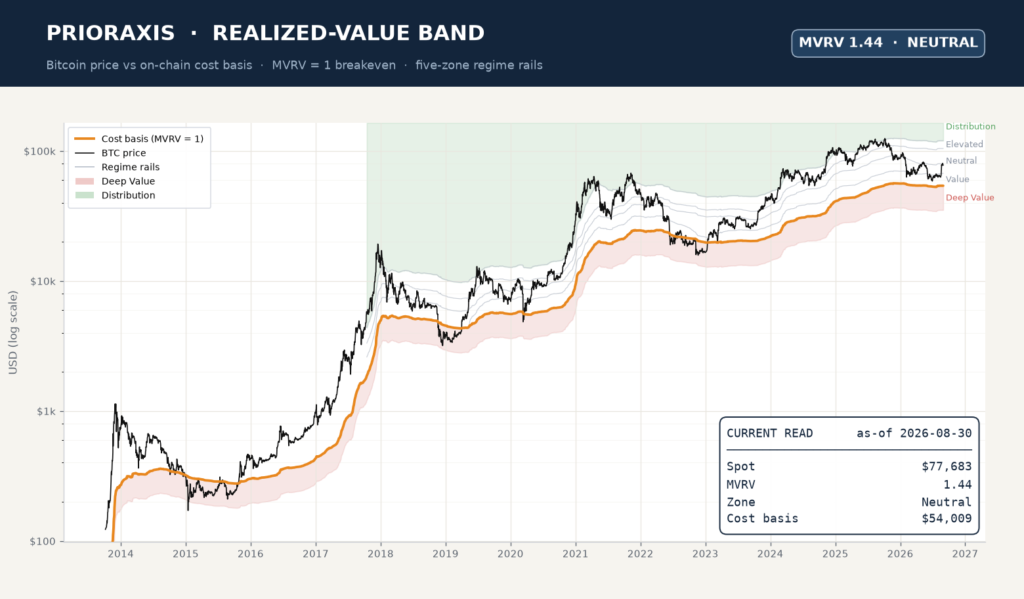
The zone word this week is Value — the durable reading, standing since early August, five Mondays running. The raw weekly reading is Neutral for a second week. The durable word changes only when a new reading holds, and it has not held. The word follows the rule, not the week. The label printed on the chart is that raw weekly reading.
Price stands at 1.44 times what the market as a whole paid for its coins, unchanged from a week ago at this precision. Read the ratio with its caveat intact: the denominator — the realized value — is still held at 10 August under a ruled data hold, now three weeks old, so part of that figure is the hold rather than the market. What can be said honestly is that the market is not measurably cheap. How far from cheap remains outside measurement, and this page says so rather than estimating it.
The chart shows one measure: price against what the market as a whole paid for its coins. The engine’s own reading is broader — a composite of five measures, four of them on-chain and one price against its own long-term average, blended into one number between 0 and 1, where lower means cheaper. A normalised form of the chart’s ratio is one of the five. The composite enters the week at 0.3916, up from 0.3704. All five components rose or held, and the largest step came from the Puell measure, which reads what miners earn against their own recent average. But the week’s fact is not that number. For the first time in this record, the value composite rose while the market’s internal measures fell — the internal score moved 37.5 to 35.6 in the same week the value reading advanced. The two instruments read different things, and this week those things disagreed.
The disagreement is specific and it is worth naming precisely. Coins moved, in aggregate, at a small loss for the first time in this record — the spend ratio crossed below one, to 0.9998, from 1.03. The thirty-day change in coins held on exchanges collapsed from about 20,500 to roughly 675, so the supply that had been positioning onto venues stopped arriving. Breadth outside bitcoin fell from 43 to 26. Against that, the fund channel stayed strong: 1.84 billion dollars net into the spot ETFs across the closed week’s seven posted sessions. So demand through the regulated channel held while the behaviour of existing holders cooled. That is what the record shows; which of the two governs from here is not something this page will guess.
Nothing was bought. The sizing ran in full and produced a number: with the target at 72.67 percent of book and the position at 51.5, the week’s computed step came to 0.30 percent of book — below the one-unit minimum that makes an order worth placing. It banks rather than executes, taking the accumulator to 0.42 percent. This is the second consecutive week of that shape, and it is the engine’s own output, not a decision to sit out. A week in which nothing fills is a complete record.
Confirmation stayed off for a second week. The composite at 0.3916 still sits inside the deep-value band, and the engine still declines to confirm it: price is 21 percent above its two-hundred-week average, no component sits at its floor, and neither of the two routes to confirmation is open. The number and the commitment are different things, and the gap between them is the whole of this week’s honesty.
Two things are watched. Whether the fund channel’s demand is corroborated by the behaviour of holders, or continues to diverge from it — that settles over weeks, not days. And the realized-value hold, now three weeks old, which is the reason the cost-basis figures on this page carry a caveat instead of a full stop. When it lifts, this page reports what it shows.